Coupling
| Manufacturer | Stromag |
| Product Code | 821-00048 |
| Product HSN Code | 84836090 |
| Shipping | Shipped in 6-8 weeks |
| Stock Availability | Available On Demand |
PRODUCT DESCRIPTION / OVERVIEW
Advantage of the Coupling:
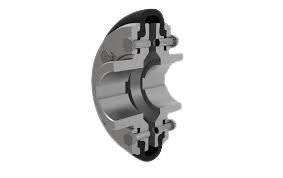
- The Stromag 821-00048 coupling is a high-quality flexible coupling element designed for reliable torque transmission while effectively absorbing shock loads and vibrations in industrial drive systems. Manufactured using a durable rubber-fabric composite, this coupling component provides excellent torsional flexibility, allowing it to compensate for axial, radial, and angular misalignments between connected shafts. Its elastic design helps protect motors, gearboxes, and driven equipment from sudden load changes, reducing mechanical stress and extending overall system life.
- Commonly used in applications such as electric motor drives, pumps, compressors, conveyors, and generator sets, the 821-00048 coupling element is engineered for continuous-duty operation with minimal maintenance. The robust construction ensures long service life, stable performance, and quiet operation, making it suitable for demanding industrial environments. As part of Stromag’s proven coupling solutions, this component delivers dependable performance where smooth power transmission and vibration damping are critical.
ABOUT THE PRODUCT
| Country of Origin: | USA | |||||||
| Industry the product belogs to: |
| |||||||
| Application of the product: | IoT Solutions | |||||||
| Supplier location: | Navi Mumbai |
PRODUCT SPECIFICATIONS
| Torque Transmission: | High, model dependent Nm |
| Maximum Speed: | Model dependent rpm |
| Operating Temperature : | Range –30 to +80 °C |
FAQs
A coupling is a device used to connect two shafts together at their ends to transmit power.
Common types include rigid, flexible, gear, grid, jaw, and elastomeric couplings.
Couplings are used to transmit torque, accommodate misalignment, and reduce shock loads between connected shafts.
Consider torque rating, speed, alignment tolerance, shaft size, and application requirements.
Misalignment, overloading, wear, improper installation, and lack of maintenance are typical causes.