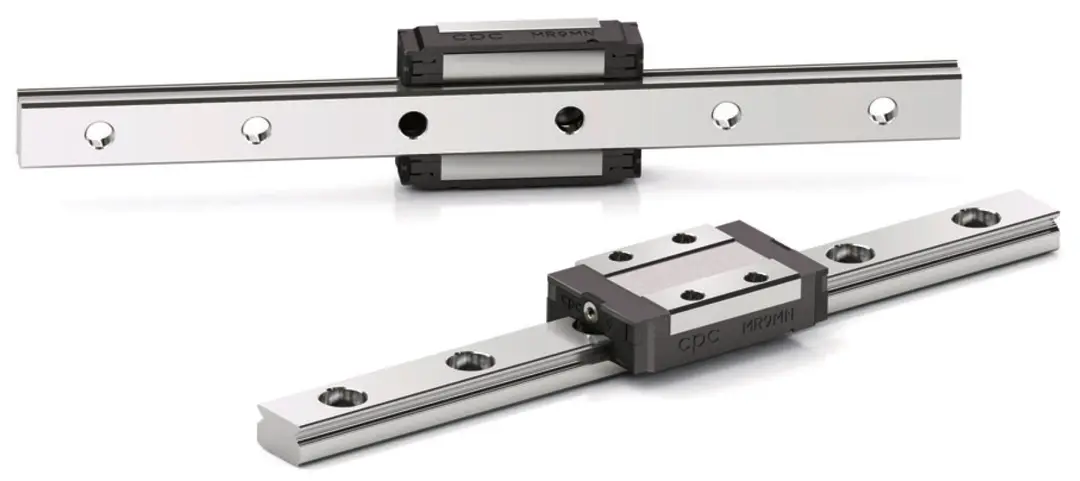
Miniature Linear Guides — Compact Precision Motion
Estimated Read Time: 7–9 minutes
Introduction
Miniature linear guides are essential components in modern compact automation systems, providing precise and repeatable linear motion while occupying minimal space. As industries move toward miniaturization, higher speeds, and tighter tolerances, these compact motion solutions play a crucial role in maintaining performance, accuracy, and reliability.
Definition of Miniature Linear Guides
A miniature linear guide is a compact rail-and-carriage system designed to guide loads in a straight line with high precision. These guides typically use ball bearings, rollers, or sliding elements to reduce friction and deliver smooth, accurate, and repeatable motion in space-constrained environments.
Structure and Components
Miniature linear guides consist of a precision-machined rail, a compact carriage, rolling or sliding elements, seals, and lubrication systems. The rail provides a stable guiding path, while the carriage supports the load and houses the rolling elements. Seals protect against dust and contaminants, and proper lubrication minimizes friction and wear, extending service life.
Types of Miniature Linear Guides
Miniature linear guides are available in several configurations including ball bearing guides for low friction and accuracy, roller guides for higher stiffness and load capacity, slide-type guides for cost-effective solutions, crossed roller guides for ultra-high precision, air bearing guides for frictionless motion, and ceramic guides for corrosion resistance and thermal stability.
Working Principle
Miniature linear guides operate by allowing rolling or sliding elements to move between the rail and carriage. These elements distribute the applied load evenly and enable smooth linear travel. Proper alignment, lubrication, and sealing ensure consistent motion accuracy and long-term reliability.
Applications of Miniature Linear Guides
Miniature linear guides are widely used in electronics and semiconductor equipment, medical and laboratory automation, packaging machinery, aerospace and defense systems, industrial automation, automotive assembly lines, optics, photonics, CNC machines, and 3D printers.
Advantages of Miniature Linear Guides
These guides offer high precision and repeatability, compact design, excellent load capacity relative to size, low friction, smooth and quiet operation, good rigidity, reduced maintenance, and wide applicability across multiple industries.
Leading Manufacturers
Miniature linear guides are manufactured by leading Indian and international companies such as THK, Hiwin, Schneeberger, IKO, Bosch Rexroth, SKF, NSK, MISUMI, Thomson Industries, and HepcoMotion, offering a wide range of sizes, configurations, and performance levels.
Conclusion
Miniature linear guides are indispensable for compact automation systems where precision, space efficiency, and reliability are critical. Their advanced design and versatility make them ideal for modern engineering applications across electronics, medical devices, aerospace, and industrial automation.
Need help selecting the right miniature linear guide for your application? Contact us today for expert guidance and customized solutions.